Reef Aquariums: How to Plan, Build, and Keep One Stable
Saltwater fish, corals, invertebrates, rock, sand, and the equipment that ties it together into a living marine ecosystem. Reef keeping is built on stability, patience, and consistency — not chasing perfect numbers. Want marine fish without corals? Read the FOWLR guide instead.
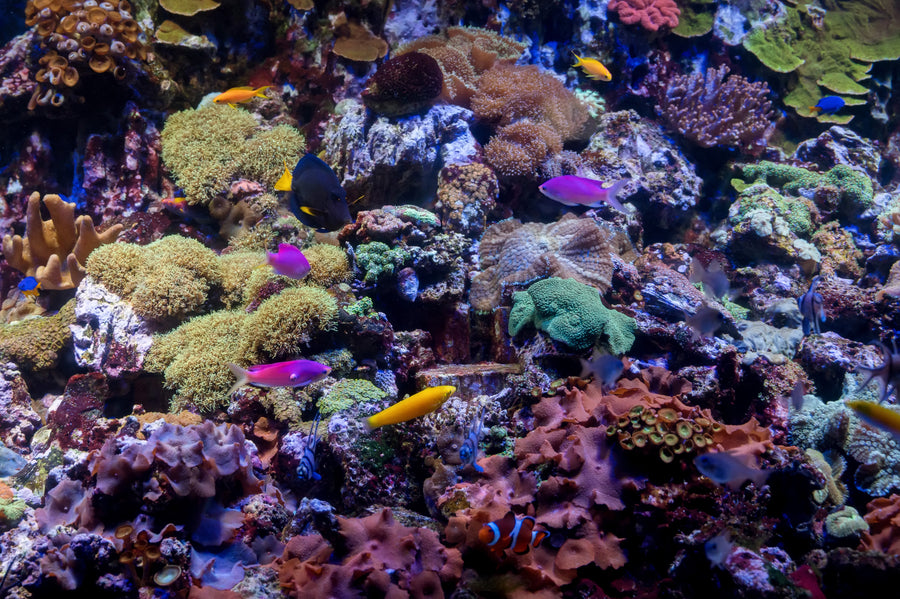
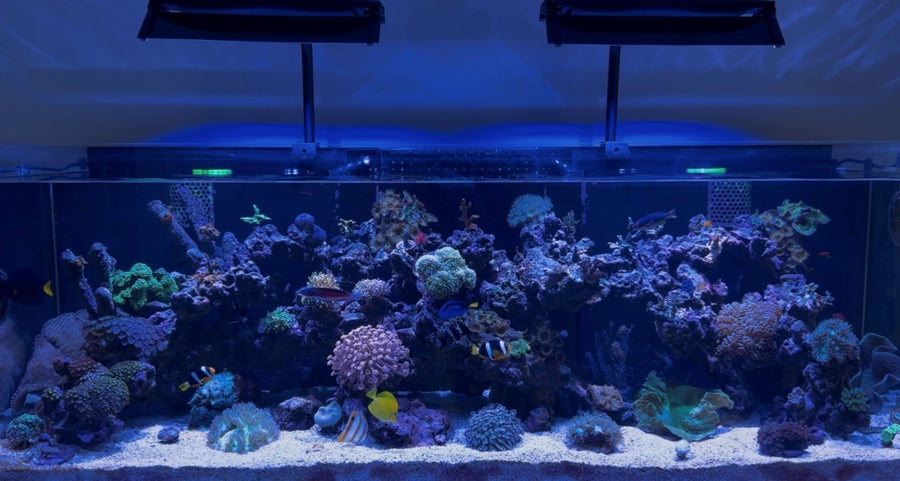
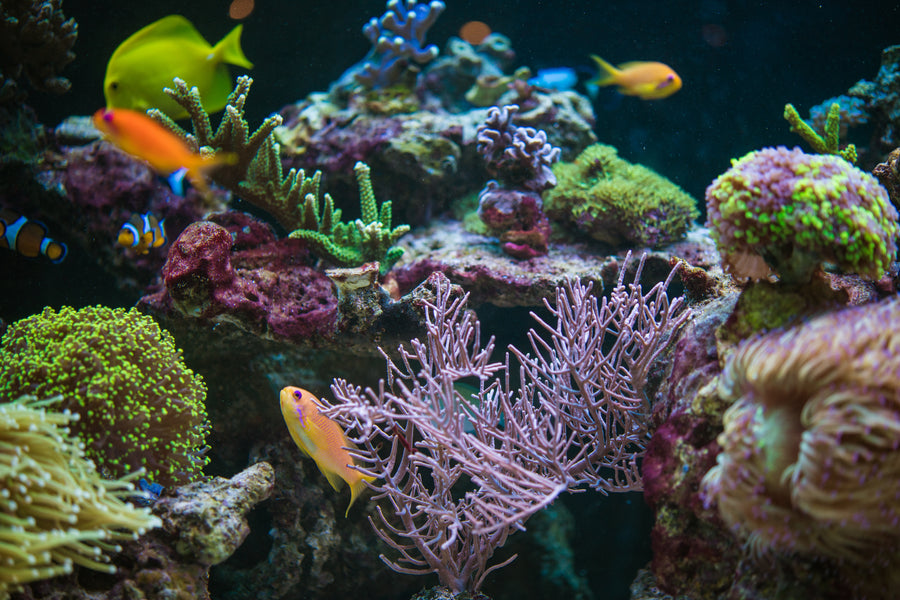
A well-planned reef is easier to run than a poorly planned simple one. The right tank size, room for equipment, proper rockwork, variable flow, and automated top-off and dosing remove most of the problems reef keepers used to manage by hand. The goal isn't zero maintenance — it's a stable system where the gear handles the repetitive work and you watch the animals.
Is a reef aquarium right for you?
Why people love it
- Marine fish, corals, and invertebrates in one living ecosystem
- Corals grow and change — the display evolves for years
- Enormous variety of coral colors, textures, and growth forms
- Rockwork doubles as biological filtration and fish habitat
- Modern gear automates top-off, dosing, lighting, and flow
- Scales from a compact coral display to a large custom install
What to know going in
- Needs more water-chemistry stability than freshwater
- Fish, corals, and inverts must be compatible with each other and the reef style
- Corals have different light, flow, and placement needs — and they fight for space
- New marine fish should be quarantined before entering the display
- Evaporation shifts salinity, so an auto top-off is close to mandatory
- As corals grow, alkalinity and calcium consumption usually means dosing
- Higher initial investment than a basic freshwater tank
Soft coral, LPS, SPS, or mixed?
The corals you want set the lighting, flow, chemistry, equipment, and maintenance. Decide the reef style before buying equipment and the system builds itself around it.
Soft coral reef
Movement, color & forgiving coralsBest for
A colorful reef with lots of movement and generally forgiving coral choices.
Typical corals
Zoanthids, mushrooms, leathers, Ricordea, clove polyps.
Light / Flow
Low to moderate light · low to moderate variable flow
Care
Beginner to moderate
LPS reef
Large polyps, color & movementBest for
Big, colorful, fleshy corals with dramatic movement and variety of shapes.
Typical corals
Euphyllia, Micromussa, Blastomussa, Favia, Favites, Lobophyllia, Trachyphyllia.
Light / Flow
Moderate light, varies by species · low to moderate indirect flow — direct blasts damage tissue
Care
Moderate
SPS reef
High energy & maximum stabilityBest for
Experienced keepers who want branching and encrusting corals and fast growth.
Typical corals
Acropora, Montipora, Stylophora, Pocillopora, Seriatopora.
Light / Flow
Moderate to high light with proper PAR and coverage · strong, broad, variable flow from multiple directions
Care
Advanced
Mixed reef
Beautiful — but more complicatedBest for
Combining softies, LPS, and SPS in one tank.
The challenge
Different coral groups need different light, flow, placement, and space — and they compete with sweepers, contact, shading, and chemical warfare.
Planning
Rockwork must create distinct light and flow zones with room to grow.
Care
Advanced
A little of everything sounds simpler than an SPS tank. In practice it's harder: you're building several environments inside one aquarium. An SPS system is designed around strong flow, high light, and tight chemistry; a softie or LPS system around its own needs. A mixed reef has to satisfy all of them while managing placement, shading, growth, and competition.
Nano reef or full-size reef?
Smaller is not easier. Less water means temperature, salinity, nutrients, and chemistry swing faster. Bigger systems cost more and need more space, but the extra volume and room for filtration make stability far easier.
Nano reef · under 20 gal
- Best for: a small coral-focused display with very limited fish — typically 1–3 small fish
- Pros: compact footprint, lower tank cost, all-in-one designs stay clean and simple
- Cons: changes happen fast, little room for equipment, evaporation shifts salinity quickly, big weekly water changes
- Add anyway: an auto top-off, and as coral demand grows a single-head dosing pump with an all-in-one supplement like Tropic Marin All-For-Reef
Full-size reef · 3 ft+ with a sump
- Our starting point: the smallest full-size reef we generally recommend is about a three-foot tank with a sump
- Why a sump: adds volume and gives heaters, probes, skimmer, dosing lines, ATO, and algae filtration a home outside the display
- Pros: more stability, more room for fish and coral growth, equipment out of sight, automation is easy to add
- Cons: higher initial cost, more space, bigger water changes, more lighting and flow, equipment planning matters
Shop Tanks & Stands → UNS All-in-One Tanks Not sure? See them in the showroom
Rockwork: the foundation of your reef
Rock isn't decoration — think of it as the kidneys of the system. Porous rock is surface area for bacteria, habitat for fish, mounting points for corals, and the physical structure of the reef. It has to work biologically and functionally before it works visually.
Starting dry gives you control over what enters the tank and lets you build, stack, secure, and rebuild the aquascape without livestock waiting on you. Once the scape works, fill it and let the rock go live through the fishless cycle. Don't build a pile of rock — build a reef structure where every piece has a purpose. Shop reef rock → · See our reef aquascaping guide
Reef equipment: what each piece is for
You don't need everything on day one, but design for it from the start. Every piece should solve a problem: remove waste, hold salinity, control temperature, deliver light and flow, replace what corals consume, or automate something that benefits from consistency.
Sump
The equipment centerAdds volume and houses filtration, heaters, probes, skimmer, dosing lines, and algae filtration out of the display. For full-size reefs we strongly prefer a tank designed around a properly sized sump.
Protein skimmer
Remove organics before they break downPulls dissolved and suspended organics out before they decompose in the tank, and adds significant gas exchange. A core part of nutrient management on most full-size reefs.
Algae turf scrubber
Biological nutrient exportGrows algae outside the display where it eats nitrate and phosphate; harvesting it physically removes those nutrients. Powerful on larger reefs as they mature.
Automatic top-off
Salinity stabilityWater evaporates, salt doesn't. An ATO replaces evaporation with RO/DI water through the day so level and salinity stay consistent. The simplest stability upgrade there is.
Dosing pumps
Small, consistent additionsGrowing corals consume elements. Dosing replaces them in small amounts through the day instead of big manual hits. A nano may need one head; a large reef may run several channels.
Reef lighting
Light the corals, not just the tankChosen for the corals you'll keep, the tank dimensions, coverage, and the PAR needed at each level of the rockwork. Powerful doesn't mean proper — coverage, height, spectrum, and consistency all matter.
Return pump
Move water through the filtrationMoves water sump-to-display and back. Size it for the tank, plumbing, overflow, and turnover — not as the source of coral flow. That's the wavemakers' job.
Heater & controller
Stable temperature, monitoredProperly sized heating placed in moving water. An aquarium controller can monitor and automate temperature, dosing, feeding modes, lights, and pumps, and alert you before a small problem becomes a big one.
Quarantine tank
Protect the displayA small separate system to observe and treat new fish before they enter the reef. Once a parasite is in a fully stocked reef, catching fish out of the rock is brutal. Plan for it.
Move water through the entire reef
Corals depend on moving water for gas exchange, food, waste removal, and keeping debris off their tissue. The goal isn't more flow — it's broad, variable movement that reaches around and through the rockwork without blasting corals from one direction all day.
How we build flow
- Return pump circulates through the filtration; it shouldn't carry the display's flow
- Controllable DC wavemakers — adjustable, programmable output instead of one fixed stream
- Variable patterns — speed and direction change through the day like a real reef
- No dead spots — pathways around, behind, and through the rock so detritus can't pile up
- Plan pumps with the rockwork — where they mount, where the water goes, what happens at the far wall
- Re-check as corals grow — a mature colony redirects flow a frag never did
Different corals, different flow
- Soft corals: low to moderate variable flow that keeps them gently moving without folding
- LPS: low to moderate indirect flow — direct blasts keep tissue retracted or tear it
- SPS: strong, highly variable flow that reaches through increasingly dense colonies
Give your corals room to grow
Corals look stationary but they're constantly competing for space, light, and flow. A spread of small frags becomes a crowd of fighting colonies surprisingly fast.
Empty space is room for the reef to grow. Give corals separation, know which species get aggressive, and leave yourself access to maintain colonies later. This matters most in a mixed reef, where softies, LPS, and SPS are competing for territory as well as sharing light and chemistry. Browse our corals (in-store only) →
Stability beats chasing a perfect number
Corals adapt to reasonable conditions; they respond badly to conditions that keep changing. Automation takes the repetitive jobs and does them the same way every day. It doesn't make the tank maintenance-free — it makes it predictable.
What to automate
- Top-off: small RO/DI additions all day instead of a big manual pour
- Dosing: alkalinity, calcium, and trace elements replaced as consumed
- Lighting & flow: programmed photoperiod and changing wavemaker patterns — then leave the settings alone
- Nutrient export: skimmer, scrubber, mechanical and chemical filtration, water changes on a predictable schedule
- Monitoring: a controller that alerts you before a heater or probe failure becomes a crash
Rules we dose by
- Test before you dose. Supplement what the reef actually consumes, not what a reef is "supposed" to use
- Microdose. Split the daily amount into many small doses — one big addition spikes, then decays
- Re-check as the reef grows. Consumption climbs with coral mass; last spring's program may be wrong now
- Look at the trend, make deliberate changes, then give the system time to respond
- Automation doesn't replace you. ATOs fail, lines clog, probes drift. Keep observing, testing, and verifying
Reef aquarium checklist
What you need depends on the size and style of reef. Some of this is day-one; some comes in as the reef matures. Build for the reef you're planning, not just the one you fill today.
Start with these
- Reef-ready aquarium & standSized for the fish and reef you want, with room for equipment
- Sump or AIO chambersDedicated space for filtration and gear
- Return pumpSized for tank, overflow, plumbing, and turnover
- HeaterProperly sized, in moving water
- Reef lightingFor the dimensions and corals you intend to keep
- DC wavemakersControllable, broad, variable flow
- Dry reef rock & dry sandFiltration, habitat, coral placement, structure
Water & testing
- RO/DI waterFor mixing salt and replacing evaporation
- Quality reef saltFor startup and water changes
- RefractometerAccurate salinity
- ThermometerIndependent temperature check
- Cycle tests: ammonia, nitriteNon-negotiable for cycling
- Reef tests: alk, nitrate, phosphate, Ca, MgAs the reef develops
Filtration & nutrient control
- Protein skimmerSized for tank and bioload
- Mechanical filtrationSocks, rollers, or pads
- Activated carbon or PurigenDissolved organics and clarity
- Algae turf scrubberOptional but powerful export as the reef matures
Stability & automation
- Auto top-off + RO/DI reservoirStable salinity
- Dosing pump & containersWhen testing shows consumption; plan cabinet space now
- Controller / monitoringOptional at startup, valuable later
Maintenance & quarantine
- Algae scraper, siphon, water-change gearSized for the tank
- Mixing container & pumpDedicated to new saltwater
- Fish & coral foodsMatched to what you're actually keeping
- Quarantine tankSimple filter, heater, thermometer, nonporous hides
How to plan and set up a reef aquarium, in order
The biggest mistake in reef keeping is buying the tank and gear before deciding what will live in it. Start with the animals, build the system around them, and grow the reef in stages — setup day is not the finish line.
Choose your fish and coral goals first
Which marine fish, and softie, LPS, SPS, or mixed. Size, behavior, aggression, swimming needs, coral compatibility, light, and flow drive everything after.Choose the aquarium around the livestock
Big enough for the adult animals, not the ones in the bag. If that tank doesn't fit your space or budget, change the fish list, not the tank.Plan the equipment before building the reef
Where the sump, skimmer, return, heaters, wavemakers, ATO reservoir, electrical, and future dosing will live. Not all installed now — but nowhere to put it later is a real problem.Build the rockwork with dry rock
Caves, broken sight lines, coral shelves at different heights, plenty of negative space. Plan it with the wavemaker positions so water moves around, behind, and through.Add sand and saltwater, start the fishless cycle
Mix salt with RO/DI, fill, run filtration, heat, and flow, and dose an ammonia source until the biology processes ammonia and nitrite to zero. Don't rush it because it looks ready. Read the saltwater cycle guide · Use the calculatorConfirm the cycle by testing
Not by the calendar. Cycled is the biological foundation, not maturity — a new reef keeps developing for months.Introduce copepods
Seed the rock and substrate with pods and let populations establish. A reef is more than fish and coral.Quarantine new fish
Observe and treat away from the display. Catching a sick fish out of a mature reef is nearly impossible; prevention is easy. Read the quarantine guideAdd hardy fish first, gradually
Easy species first so the biology keeps up; territorial species later so the order controls aggression.Let the reef develop, then add corals slowly
Watch nutrients, salinity, temperature, and equipment settle. Start with corals suited to your reef style — don't cover every rock with frags at once.Place corals for their needs and future size
By light, flow, aggression, and growth. Leave room for colonies, especially around aggressive LPS, fast softies, and branching SPS.Test, observe, dose on consumption, automate
Track alkalinity and calcium use as coral mass grows and dose what's consumed. Add ATO, dosing, controllers, and export as consistency helps — without replacing observation, testing, and maintenance.Go deeper before you fill it
Saltwater Fishless Cycle
How the cycle works in saltwater and when the tank is ready.
Reef aquascapingHow to Aquascape Reef Rock
Height, negative space, and flow paths on the UNS R90.
Protect your reefWhy Quarantine New Fish
The one reason that surprises most reef keepers.
System buildPlumbing an Internal Overflow
Display to sump and back, step by step.
FiltrationWet/Dry or Sump?
What each does and which fits a larger marine system.
WatchYouTube Channel
Reef builds, equipment demos, and livestock walkthroughs.
Want the reef designed, plumbed, installed, and maintained?
Reef tanks have a lot of moving parts. Visit the Lauderhill showroom and our marine biologist on staff will plan the system around your space, budget, and the fish and corals you want — first reef, upgrade, or large custom install. Every service is à la carte: the whole project or just the parts you need.
Reef aquarium FAQ
What's the best size for a first reef tank?
If space and budget allow, about a three-foot tank with a sump. The extra water volume and equipment room make stability much easier. A nano can work, but treat it as a small reef, not an easy one.
Should I start with live rock or dry rock?
We recommend dry rock and dry sand. You control what enters the system, you can build and rebuild the scape without livestock waiting, and the rock goes live during the fishless cycle.
Do I need a protein skimmer?
On most full-size reefs, yes. It removes organics before they break down and adds gas exchange. Small all-in-one nanos often run on water changes, carbon, and light stocking instead.
When do I need to start dosing?
When testing shows consumption. A new reef with a few frags usually needs only water changes. As coral mass grows and alkalinity and calcium drop between changes, add dosing — in small doses spread through the day.
Do I really need to quarantine fish?
Yes. Once a parasite is in a fully stocked reef, catching and treating fish around the rock is extremely difficult. A small quarantine tank is part of the reef plan.
Can you design and install a reef aquarium for me?
Yes. We design, aquascape, plumb, deliver, and install throughout Broward, Palm Beach, and Miami-Dade, starting at $150 for a small aquarium with décor, and we offer ongoing reef maintenance. Corals and marine fish are sold in-store only.


