Planted Aquariums: How to Choose, Plan, and Set One Up
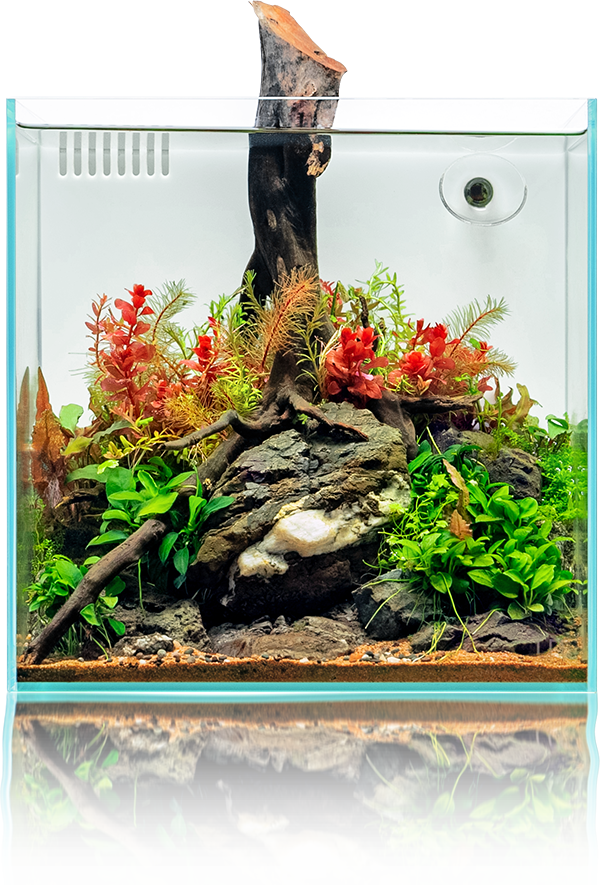
Live plants, natural stone and wood, and freshwater fish or shrimp in one growing underwater landscape. It can be as simple as a low-light tank with Anubias and Java fern or as advanced as a CO2-injected aquascape with carpeting plants. The secret isn't expensive gear — it's balance between light, CO2, nutrients, livestock, and routine. Prefer fish without plants? Read the Freshwater Aquarium guide instead.
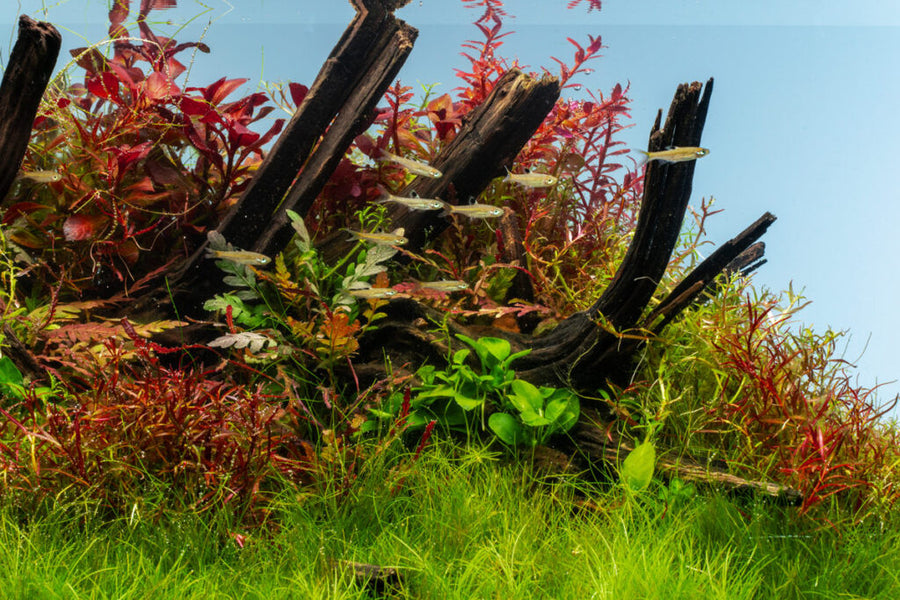
The livestock decides the temperature, water chemistry, and behavior the plants have to live with. A discus tank kept around 84°F limits your plant list compared with a cooler community tank, and some fish dig, graze, or uproot. Choose the fish, then pick plants that thrive under the same conditions.
Is a planted aquarium right for you?
Why people love it
- A living display that grows and changes over time
- Scales from low-tech and easy to high-tech and demanding — you choose
- Plants give fish and shrimp cover, grazing surfaces, and enrichment
- Healthy plants consume nutrients and become part of the filtration
- Endless design options with plants, stone, wood, and open space
- Many beginner plants grow well without injected CO2
What to know going in
- Plants must match the temperature and water your fish need
- They also have to match your light, substrate, nutrients, and CO2
- New plants may melt while adapting to submerged growth
- Too much light without enough CO2 and nutrients invites algae
- Fast growers need regular trimming and replanting
- Some fish dig, uproot, or eat plants
- High-tech tanks demand consistency: CO2, ferts, light, and maintenance
Low-tech, medium-tech, high-tech, or epiphyte?
Not every planted tank needs the same gear or effort. Once you know the livestock, pick the style that matches your plant list, experience, and how much maintenance you actually want to do.
Low-tech
Simple & lower maintenanceBest for
Beginners, offices, natural displays, anyone who wants plants without pressurized CO2.
Typical plants
Anubias, Java fern, Bucephalandra, Cryptocoryne, mosses, selected swords.
Light / CO2
Low to moderate light · no injected CO2
Care
Low to moderate
Medium-tech
More variety & controlBest for
More plant variety and faster growth without committing to a full high-tech build.
Typical plants
Easy stems, swords, Cryptocoryne, epiphytes, mosses, some foreground plants.
Light / CO2
Moderate, controlled light · CO2 optional but helpful
Care
Moderate
High-tech
Maximum growth & controlBest for
Dense growth, carpets, red plants, detailed aquascapes, demanding species.
Typical plants
Carpeting plants, demanding stems, reds, fine-leaved species, tissue cultures.
Light / CO2
Moderate to high light · stable pressurized CO2 strongly recommended
Care
Advanced
Epiphyte aquascape
Wood, stone & attached plantsBest for
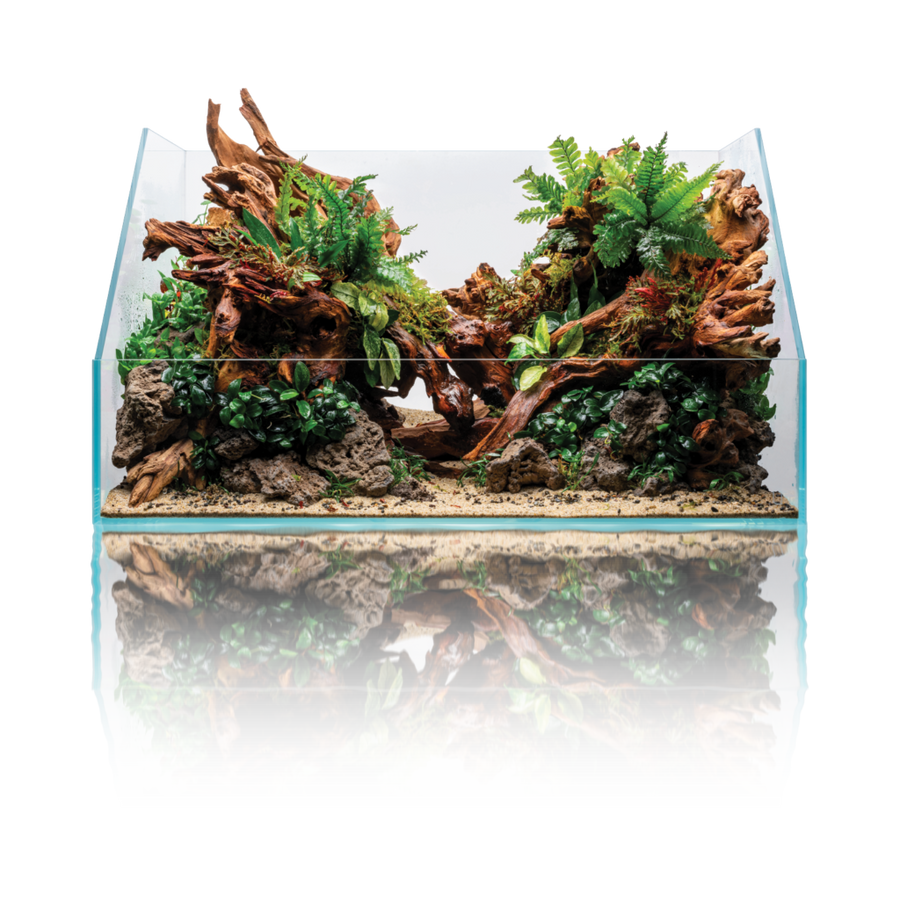
Layouts built on hardscape with plants attached to wood and rock instead of rooted throughout the substrate.
Typical plants
Anubias, Bucephalandra, Java fern, Bolbitis, mosses.
Light / CO2
Low to moderate light · CO2 optional
Care
Low to moderate
Planted aquariums for almost any space
Size the tank around the adult fish first, then plan plants, hardscape, and equipment around them. Small tanks make detailed scapes but swing fast; big tanks give depth and stability but need real planning.
Nano planted
Betta, shrimp, snails, or a few nano fish with Anubias, Buce, mosses, small crypts.
Small volume means changes happen fast — stay consistentSmall aquascape
Small tetras, rasboras, corydoras, shrimp; crypts, stems, epiphytes, carpets.
Respect adult size and school sizesPlanted community
Bigger schools, gouramis, dwarf cichlids; multiple plant zones and stronger compositions.
Plan plant height so fish keep swimming roomLarge planted display
Rainbowfish, angelfish, discus, big schools; large swords, tall stems, feature specimens.
Circulation, light coverage, and access matterLarge-scale aquascape
Architectural showpiece for homes, offices, restaurants, and custom installs.
CO2 distribution, trimming access, and water-change logistics need a planShop UNS Tanks & Stands → All Tanks & Stands Not sure? See them in the showroom
How aquarium plants feed
Plants don't all take in nutrients the same way. Knowing which kind you're growing decides whether you need aquasoil, liquid fertilizer, root tabs — or all three.
Water-column feeders
- How they feed: through leaves and stems, straight from the water
- Examples: Anubias, Java fern, Bucephalandra, mosses, many stem plants
- Fertilize with: a quality liquid fertilizer dosed to the water
- Substrate: aquasoil not required — epiphytes attach directly to rock or driftwood
Root feeders
- How they feed: through substantial root systems in the substrate
- Examples: Amazon swords, Cryptocoryne, Vallisneria, carpeting plants
- Fertilize with: nutrient-rich aquasoil or root fertilizers at the roots
- Substrate: put aquasoil where rooted plants will actually grow
If the scape is epiphyte-heavy or rooted plants only go in certain zones, place nutrient-rich substrate only where it's needed. Planning the hardscape and planting zones first saves money and keeps aquasoil from ending up under decorative sand or bare rock. Shop soil, sand & substrates →
Choosing the right filter for a planted tank
A planted tank's filter does three jobs: biological filtration, debris removal, and moving nutrients and CO2 through the whole scape. Dense plants and big hardscape create dead spots, so circulation matters as much as capacity.
Sponge
Simple & gentleBest for
Nano tanks, shrimp, bettas, breeding, low-tech setups that want gentle flow.
Pros
Excellent bio · gentle · shrimp and fry safe · cheap · easy
Cons
Little mechanical filtration · visible in the scape · air agitation drives off CO2
Hang-on-back
Easy all-rounderBest for
Small to medium low-tech tanks where simplicity and easy access win.
Pros
Easy install and cleaning · good mechanical + bio · affordable · no plumbing
Cons
Less media than a canister · waterfall agitation if the level drops · less ideal with injected CO2
Canister
Our planted-tank pickBest for
Medium and large planted tanks, scapes where looks matter, CO2 systems that need controlled flow.
Pros
Big media capacity · strong controllable circulation · quiet · gear stays outside · pairs with lily pipes and inline CO2/heaters
Cons
Higher cost · hose and seal maintenance · must be sized to reach the whole scape
Sump / wet-dry
Maximum capacityBest for
Very large planted displays, custom installs, heavily stocked systems.
Pros
Huge bio and mechanical capacity · adds water volume · hides heaters and gear · customizable
Cons
Overflow, return pump, and plumbing · more complex · design it to limit CO2 loss
Sponge for a shrimp or betta nano. HOB for small low-tech tanks. For most medium and large planted displays we recommend a properly sized canister: it filters well, circulates well, and keeps the equipment out of the aquascape. Sump for very large or custom systems. Shop filters →
Lighting, CO2 & fertilization
Light drives growth, CO2 supplies the carbon, fertilizer supplies the building blocks. Push one without the other two and you get weak plants and algae.
Lighting
Match the light to the plantsLow light
Anubias, Java fern, Bucephalandra, mosses, and many crypts thrive without powerful lighting.
Higher light
Carpets, most red plants, and demanding stems need stronger, controlled light.
More is not better
Excess light pushes demand past your CO2 and nutrients. Start conservative and add intensity only when the plants ask for it. Shop lights →
CO2
Carbon for growthRequired?
No. Easy plants grow without it. It becomes valuable as light and plant demand rise.
Why use it
Better growth, density, color, carpeting, and a much wider plant list.
Consistency
Plants respond to stable CO2 on a predictable daily schedule, distributed through the tank. Never push it at the expense of fish or shrimp — their behavior is your warning sign. Shop CO2 →
Fertilization
Feed the plants consistentlyWhy
Plants need macro- and micronutrients; fish waste alone rarely covers it.
Liquid
Feeds the water column — epiphytes, stems, and mosses.
Root
Aquasoil or root tabs feed swords, crypts, and carpets at the roots.
Routine over guessing
Use a repeatable dosing routine, not random additions after every change. Shop fertilizers →
Planted aquarium checklist
Once the fish, compatible plants, and scape style are decided, this is everything you need before the cycle starts.
- Aquarium & standSized for adult fish, with footprint and height for the scape
- FilterBio capacity plus circulation through plants and hardscape
- Heater & thermometerSet for both fish and plants; verify actual temperature
- Planted aquarium lightBy tank dimensions and plant needs — not just the brightest
- Light timer or controllerA consistent daily photoperiod, automated
- SubstrateAquasoil where rooted plants go; sand or rock elsewhere
- Rock & driftwoodPlan the hardscape before planting
- Aquatic plantsMatched to livestock, temperature, light, substrate, CO2
- Plant fertilizerLiquid, root tabs, or both
- CO2 system — when neededHigh light, carpets, demanding plants
- Water conditionerNeutralizes chlorine and chloramine
- Test kit: ammonia, nitrite, nitrate, pHNon-negotiable for cycling
- GH & KH test kitMatch livestock and plants to your water
- Ammonia source for cyclingFeeds the bacteria before livestock arrives
- Aquascaping & maintenance toolsScissors, tweezers, algae tools, siphon, aquarium-only buckets
How to plan and set up a planted aquarium, in order
We recommend a dark start: build the hardscape, fill, and complete the fishless cycle with the light off — then plant into a mature filter instead of asking new plants to survive a brand-new system.
Choose your fish first
Adult size, temperature, pH and hardness, behavior, schooling, aggression, and compatibility. A discus tank at 84°F narrows the plant list before you buy one plant.Choose plants that match the livestock
Same temperature and water, and compatible behavior — diggers, grazers, and open-water swimmers change what you can plant and where.Decide the aquascape style
Epiphyte scape, lightly planted, heavily rooted, or a mix. Think foreground, midground, background, and open swimming space — depth and structure, not every inch filled.Plan the hardscape before the substrate
Rock and wood set focal points, height, territories, sight-line breaks, and planting zones. Then put aquasoil only where rooted plants will actually grow.Choose the aquarium and equipment
Big enough for the adult livestock and the scape. Filter, heater, light, timer, CO2 if needed. Too big for the space or budget? Change the plan, not the tank size the fish need.Build the hardscape dry
Substrate where needed, full rock and wood structure, checked from normal viewing angles. Big changes are much harder after it's filled and planted.Dark start: fill and complete the fishless cycle
Condition the water, run filter and heater, dose an ammonia source — light off, no plants yet — until the filter clears ammonia → nitrite → nitrate with none left over. Read the guide · Use the calculatorConfirm it's cycled by testing
Not by the calendar. The tank should process a challenge dose to zero ammonia and zero nitrite.Drain, plant, refill
Lower the water to plant accurately. Rooted plants go into the prepared zones; attach epiphytes to rock or wood. Never bury an Anubias, Buce, or Java fern rhizome. Refill gently so nothing shifts.Start light, ferts, and CO2
Begin the routine your plant list needs. Start conservative on light — around six hours a day is a reasonable opener — and adjust as the tank matures.Let plants settle, then retest
Some melt is normal during the transition to submerged growth. Wait a few days and confirm ammonia and nitrite are back at zero.Add fish gradually, then maintain the balance
Gentlest species first, stocked over weeks. Then water changes, consistent fertilizing, trimming and replanting, glass and filter care — adjusting light, CO2, and flow as the scape grows in.Go deeper before you plant
Aquarium Plants Don't Have to Be Hard
How to choose plants and what they actually need to grow.
BlueprintYour First 90 Days
Fertilizer, CO2, and lighting through the critical first months.
Start hereThe Fishless Cycle
Why cycling matters and how to know the tank is ready.
Real-world setupPlanted Nano Tank Build
Tank, hardscape, planting, and our honest review of the finished system.
Want the aquascape designed, built, and installed?
Henry has been designing planted aquariums since 2008, and the Lauderhill showroom carries the largest aquascaping and live-plant section in Florida. We'll plan the tank, hardscape, plants, and livestock around your space and budget — then deliver it, set it up, and keep it healthy. Every service is à la carte.
Planted aquarium FAQ
Do I need CO2 for a planted aquarium?
No. Anubias, Java fern, Bucephalandra, Cryptocoryne, mosses, and many swords grow well without injected CO2 under moderate light. CO2 becomes important for carpets, red plants, demanding stems, and high-light tanks.
Do I need aquasoil for live plants?
Only where root-feeding plants will grow. Epiphytes attach to rock and wood and feed from the water. Many scapes use aquasoil in planting zones and sand or bare hardscape elsewhere.
Why are my new plants melting?
Most plants are grown emersed at the farm and shed those leaves while switching to submerged growth. Keep the routine steady, trim melted leaves, and new growth normally follows within a few weeks.
How many hours should the light run?
Start around six hours a day on a timer for a new tank and increase gradually as plants establish. More light without more CO2 and nutrients mostly grows algae.
What is a dark start and why do you recommend it?
You build the hardscape, fill the tank, and complete the fishless cycle with the light off, then plant into a mature filter. New plants don't have to fight an unstable system, and algae has nothing to feed on during the cycle.
Can you design and install a planted aquarium for me?
Yes. We design, aquascape, deliver, and install throughout Broward, Palm Beach, and Miami-Dade, starting at $150 for a small aquarium with décor, and we offer ongoing planted-tank maintenance.


